
RCS for Finance: Secure, Interactive Banking Notifications That Actually Work
Fraud alerts, payment confirmations, loan applications — financial services teams are building richer, safer customer experiences with RCS.
Ivan
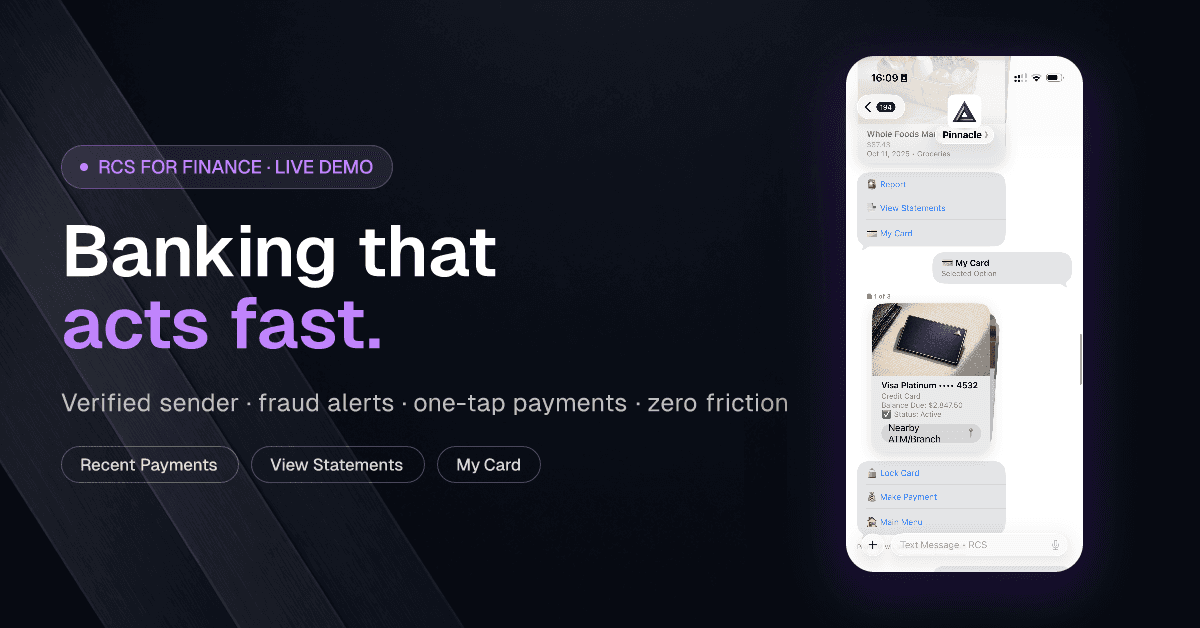
Financial institutions send millions of notifications per day. Most are delivered as SMS — a channel designed in 1992, carrying no brand identity, no security signal, and no interactivity. Customers have been trained to click links in their bank's texts. The same channel used to verify a login is used by phishers to steal one.
RCS solves both problems simultaneously: it replaces anonymous phone numbers with a verified, branded sender identity, and it replaces clickable links with native action buttons. The message thread is identifiably yours — your institution's name and logo in the header, every time.
What Finance Gets from RCS
Fraud Alerts That Resolve Themselves
A fraud alert should do one thing: let a customer confirm or deny a transaction in under three seconds. The friction in current SMS flows — read the text, identify the number, click a link, log in to the portal, find the transaction — is exactly where customers abandon the flow.
An RCS fraud alert delivers the transaction details as a structured card (merchant, amount, location, time) with two buttons: This Was Me and Block Card. The customer taps once. Your webhook fires. No portal session, no login fatigue.
await client.messages.rcs.send({
  from: "your_agent_id",
  to: customer.phone,
  cards: [
    {
      title: "Unusual charge detected",
      subtitle: `$${transaction.amount} at ${transaction.merchant} — ${transaction.location}`,
      media: "https://cdn.example.com/fraud-alert-icon.png",
      buttons: [
        {
          title: "This Was Me",
          type: "trigger",
          payload: `approve_${transaction.id}`,
        },
        {
          title: "Block Card",
          type: "trigger",
          payload: `block_${transaction.id}`,
        },
      ],
    },
  ],
});
The verified sender identity means customers aren't second-guessing whether the alert is real. The branded card is visibly from your institution, not a random +1 number. Monitor all responses in the conversations dashboard.
Payment Confirmations and Receipts
After a bill payment or wire transfer, customers want a confirmation they can trust. A rich RCS confirmation includes the payee name, amount, confirmation number, and a View Statement button that opens the relevant account page — all in a single branded message thread.
Recurring payment reminders can use the same format with a Pay Now button that deep-links to the one-tap payment flow in your mobile app or web portal.
Loan and Account Applications
New account onboarding typically requires document collection, form completion, and identity verification — all friction points where applicants drop off. RCS turns the enrollment flow into a guided, conversational experience:
- Welcome card — explains what's needed, with a Get Started button
- Document prompts — quick replies to confirm what the applicant has ready
- Deep link to upload portal — secure, single-tap access
- Status updates — a card when the application moves to the next stage
No app install. No email thread. The entire flow lives in the customer's messaging app.
Account Statements and Spending Summaries
Instead of a plain text nudge to check the portal, send a monthly summary card: total spend, top category, balance trend — and a View Full Statement button. Customers who engage with these messages have higher retention rates and lower support contact volume.
Two-Factor Authentication
RCS messages can serve as a higher-trust OTP delivery channel. The verified sender identity helps distinguish legitimate authentication messages from phishing attempts that mimic the same flow. For customers on devices that support RCS, routing 2FA through Pinnacle adds a visible trust signal at minimal incremental cost.
In-Thread Webviews for Sensitive Information
RCS supports opening a webview directly inside the messaging thread — customers never leave the app. This is the right pattern for anything that requires authentication or involves sensitive data: full account statements, transaction histories, and verification flows load in a secure in-thread browser rather than handing the customer off to an external tab. It removes the phishing ambiguity ("did my bank just send me this link?") and keeps the interaction contained and trusted.
Branded Sender Identity and Trust
Every RCS message you send through Pinnacle carries your institution's verified identity: name, logo, and a carrier-issued verified badge. This is the single most important feature for financial services — it's what distinguishes your messages from spoofed texts in the same inbox.
Pinnacle handles the RCS agent registration and verification process. You get your branded sender once and it persists across every message.
Compliance Considerations
RCS messages are regulated under the same TCPA framework as SMS. For financial services, your messaging program needs:
- Express written consent from recipients
- Clear opt-out instructions (Pinnacle supports standard STOP/UNSTOP handling)
- 10DLC registration for any SMS/MMS traffic on your number (Pinnacle handles this automatically during onboarding)
For enterprise compliance requirements or custom DPA/BAA arrangements, contact us.
Book a Call
Most financial institutions are still running fraud alerts and payment confirmations over anonymous SMS. RCS adoption in financial services is early — the teams moving now will be the ones customers trust before it becomes industry standard.
We've worked with financial teams of all sizes, from fintech startups to established banks and credit unions. Book a 30-minute call and we'll walk through your fraud alert and notification flows, handle branded sender registration, and get you live fast.
Key Takeaways
- RCS replaces anonymous SMS numbers with a verified, branded sender identity — the most critical feature for financial services messaging.
- Fraud alerts, payment confirmations, and onboarding flows all benefit from action buttons that reduce friction and keep customers in the resolution flow.
- Button taps post to your webhook in real time for immediate downstream processing.
- TCPA compliance for RCS follows the same framework as SMS; Pinnacle automates 10DLC registration during onboarding.
- Automatic fallback to SMS means no customer is missed, regardless of device support.
FAQ
1. Is RCS more secure than SMS for financial notifications? The verified sender identity is the key security upgrade — customers can confirm they're receiving a message from your institution, not a spoofed number. For message confidentiality, both RCS and SMS should avoid transmitting sensitive account numbers in the message body.
2. Can RCS button taps integrate with our core banking system?
Yes. Pinnacle sends every button tap to a webhook you configure. The payload carries the value you assigned to the button (e.g., approve_txn_123). Your handler calls your core system API to process the response.
3. Does RCS support two-way conversations for customer service? Yes. Pinnacle's inbound message handling captures any free-text reply from a customer and routes it to your webhook. You can build a fully conversational flow on top of this.