
RCS Analytics: The Business Leverage Behind Rich Messaging
RCS isn't just a richer SMS — it's the first business messaging channel with real telemetry. Here's the full extent of what Pinnacle tracks automatically, and the leverage it gives companies that no other platform can match.
Ivan

You Can't Optimize What You Can't Measure
For the past two decades, business SMS has been a one-way street. You queue a message, the carrier returns a delivery receipt that may or may not be accurate, and that's the end of the feedback loop. Did the recipient read it? Unknown. Did they care? Unknown. Did they tap the link? Maybe — if you stuffed a tracked URL in there yourself and built the click-through pipeline on your own infrastructure. Did the campaign work? You ran a coupon redemption query in your warehouse three days later and squinted at a number that may or may not have been correlated.
This is the world every messaging team has been operating in. It's why most SMS programs are tuned by gut feel, why "best practices" are folklore, and why teams routinely spend six figures a month on a channel they cannot meaningfully measure.
RCS was supposed to fix this. The protocol introduced read receipts, typing indicators, structured buttons, quick replies, reactions, and rich cards — a complete telemetry surface that makes messaging behave more like email or in-app analytics than the broadcast pipe SMS has always been. The carrier ecosystem caught up. iOS 18 closed the reach gap. RCS is no longer a niche bet — it's the protocol most of your customers are already on.
But here's the catch most teams discover six months into their RCS rollout: the protocol gives you the signals, but your platform decides whether you ever see them. And almost every platform on the market today treats RCS exactly the way it has always treated SMS: as a pass-through pipe. The interaction events come into the platform, get relayed to a webhook endpoint, and become your engineering team's problem.
This post is about the alternative. Pinnacle is the only RCS platform that captures the full interaction surface automatically, normalizes it across every carrier, and exposes it to non-engineers in a real-time dashboard and to engineers through SDKs and webhooks. It is, as far as we can tell, the most comprehensive RCS analytics layer that exists. And that's not a vanity statement — the rest of this post is about what that actually unlocks for your business, and why it should change how you think about your messaging stack.
The Full Extent of What Pinnacle Tracks
Before we get to the leverage, here's the catalog. This is every signal Pinnacle captures, normalizes, and exposes — automatically, with zero configuration, included with every account.
| Signal | What it tells you | Channels |
|---|---|---|
| Delivery status | Sent, queued, delivered, failed — at the per-recipient level | SMS / MMS / RCS |
| Read receipts | When the recipient actually opened the message, not just received it | RCS |
| Typing indicators | Whether a recipient is composing a reply right now | RCS |
| Button clicks | Which CTA was tapped, when, the payload, the button label, the metadata | RCS |
| Quick reply selections | Which suggested response the recipient chose | RCS |
| Inbound replies | Free-text responses tied back to the outbound message that prompted them | SMS / MMS / RCS |
| Reaction events | Emoji reactions to your outbound messages | SMS / MMS / RCS / iMessage |
| Message-type breakdown | What share of your traffic actually delivered as RCS vs. SMS fallback | All |
| Cost telemetry | Per-message cost broken down by channel, segment, and campaign | All |
| Conversation-level signals | Reply rate, time-to-reply, drop-off point, conversation length | All |
| Interaction rate | Percentage of RCS messages where at least one button was pressed | RCS |
| Per-button breakdown | Of all buttons sent, which were pressed and which were ignored | RCS |
A few things worth pausing on:
- Read receipts are the signal email marketers have been begging for for a decade. RCS gives them to you natively. Pinnacle exposes them per-recipient, in real time.
- Per-button click tracking is the signal that does not exist on any other RCS platform. Google's RBM API does not expose it as a first-class metric — every other vendor either ignores it or makes you build the indexing layer yourself. We covered the technical mechanics of how Pinnacle does this in Tracking RCS Button Clicks.
- Cost telemetry sounds boring until you realize that on a mixed SMS/RCS program, you cannot answer "what is my actual cost per engaged customer" without it. Pinnacle computes this for you per channel, per campaign, per day.
- Conversation-level signals turn one-off message metrics into a longitudinal view of the relationship. Reply rate is interesting; reply rate trending down across a customer cohort is a churn signal.
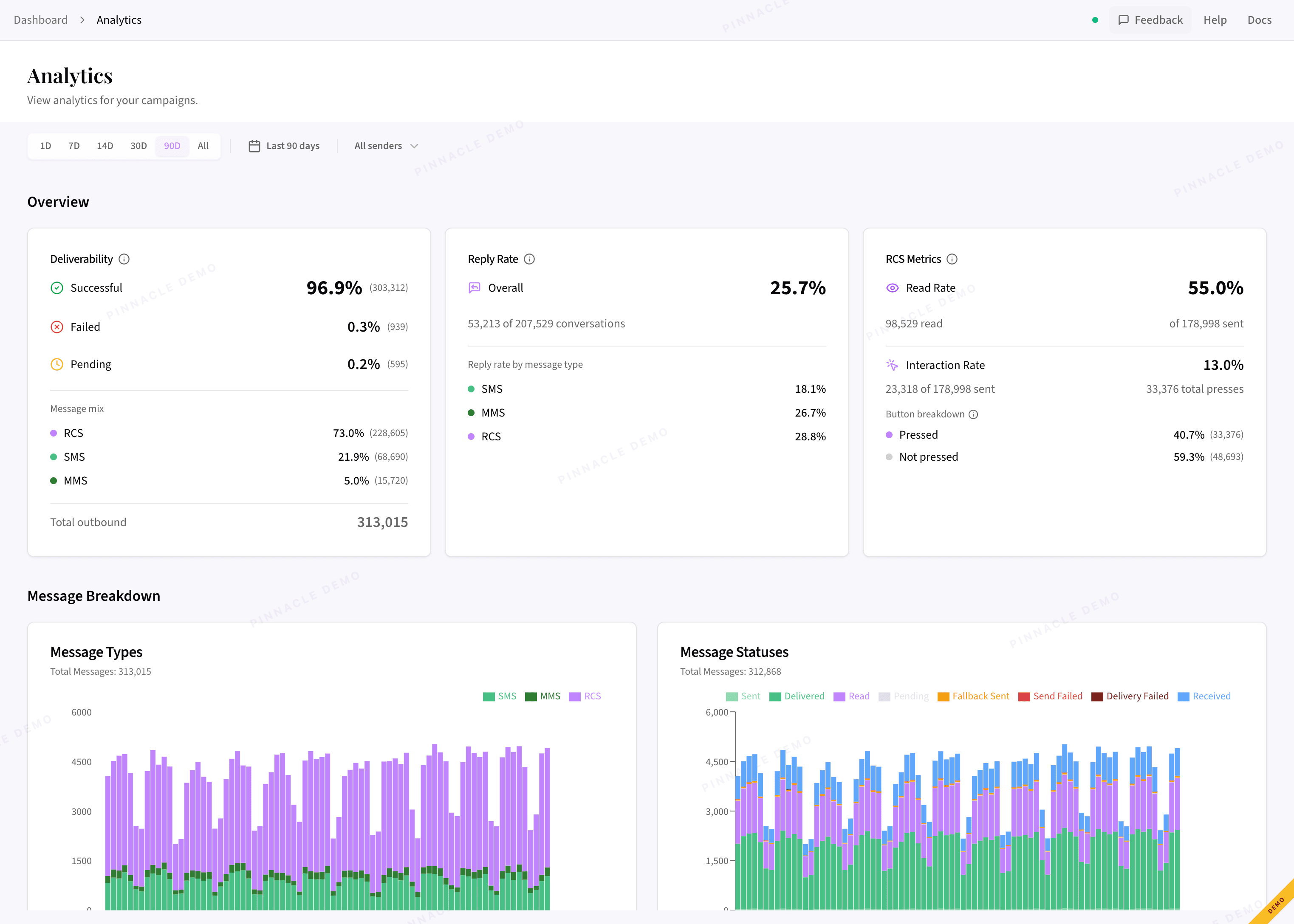 Pinnacle's analytics dashboard: deliverability, reply rate, RCS read rate, interaction rate, button breakdown, and message-type/status charts — all in one view, real-time, zero configuration.
This isn't a list of metrics on a roadmap. Every signal in this table is captured automatically the moment you send your first message through Pinnacle. There is no instrumentation step. There is no "enable analytics" toggle. There is no upgrade tier. You send a message, the data shows up.
The companion post Pinnacle Analytics Dashboard walks through the dashboard UI in detail. The rest of this post is about something different: what you can do with this data that you cannot do anywhere else, and why that should matter to anyone making messaging decisions.
Why This Is Leverage, Not Vanity Metrics
There's a meaningful difference between a metric and a lever. A metric is something you stare at on a dashboard. A lever is something you can pull to change the outcome. Most messaging analytics products are full of metrics. Pinnacle is built around levers. Here are three.
Lever 1: Channel Mix Optimization
RCS costs more per message than SMS. The premium varies by carrier and region, but a useful round number is roughly 2x for a typical campaign. The question every messaging team eventually has to answer is: is the premium worth it?
Without interaction data, you cannot answer this question. You can guess. You can point at a Google case study. You can run a one-off A/B test and squint at the conversion numbers. But you cannot, on an ongoing basis, calculate the actual cost per engaged customer for each channel and shift your spend to whichever one is winning this week.
With Pinnacle, you can. The interaction-rate-by-channel breakdown means that for every campaign, you have:
- RCS interaction rate — what percentage of RCS recipients pressed a button or replied
- SMS reply rate — what percentage of SMS recipients replied (the only engagement signal SMS gives you)
- Per-channel cost — what each channel actually cost per delivered message
- Cost per engaged customer — the metric you actually care about, computed by dividing the two
Concrete framing: if your RCS messages show 4x the click-through of your SMS fallback at 2x the cost, that's a 2x ROI argument for every campaign you've ever sent. Most teams running RCS today don't have the data to make that argument to their CFO. With Pinnacle they do.
The reverse is also true. If you discover that for a specific message type — say, a generic promotional blast to a cold list — the RCS premium isn't paying for itself, you can shift that segment back to SMS and pocket the difference. The point isn't that one channel always wins. The point is that you can make the call with data instead of guessing.
Lever 2: Message Template Tuning
Most teams pick CTA copy by gut. "Shop Now" vs. "See the Deal" vs. "Claim Your Discount" — pick one, ship the campaign, move on. The next campaign comes with new copy and the cycle repeats. There is no learning loop because there is no measurement.
Per-button click tracking turns every single message you send into a passive A/B test. You don't have to set anything up. You don't have to define experiment groups. You don't have to instrument a tracking layer. Pinnacle tracks every button at send time and records every click as it happens. Over a few weeks, the data tells you:
- Which button labels drive the most clicks for each customer segment
- Which button positions get more attention (top of card vs. bottom of card)
- Which button types perform best (rich card buttons vs. quick replies vs. URL openers)
- Which combinations of buttons are redundant (the third button that no one ever taps)
A real example of the kind of finding teams discover within their first month on Pinnacle: a DTC retailer found that the button labeled "Track my order" outperformed "View order status" by 38% — a passive discovery that took zero engineering effort and resulted in a permanent change to their post-purchase flow. The kind of optimization that, on SMS, would have required a custom URL shortener, a click-tracking server, an attribution database, and three engineering sprints.
Lever 3: Predictive Engagement Scoring
This is the one most teams don't see coming. Once you have read rates, interaction rates, and reply rates per recipient over time, you can compute a per-recipient engagement score. Use it to:
- Suppress low-engagement contacts. Recipients who haven't read or interacted with your last ten messages are unlikely to engage with the next one. Stop sending to them and you save money on every campaign while improving your aggregate metrics.
- Surface high-engagement contacts. Recipients with high interaction scores are your warmest leads. Hand them off to a sales sequence, an account manager, or a higher-touch channel.
- Detect early churn signals. A specific cohort whose interaction rate is trending down over the past sixty days is a cohort about to churn. You see this six weeks before they cancel — long enough to do something about it.
- Drive cohort experiments. Compare engagement scores across acquisition channels, signup vintages, plan tiers. The recipient-level data lets you slice it however you want.
This is the kind of analysis that, on raw SMS, is not just hard — it is structurally impossible, because the protocol doesn't expose the signals. RCS exposes them. Pinnacle is the only platform that captures and normalizes them in a way you can actually use.
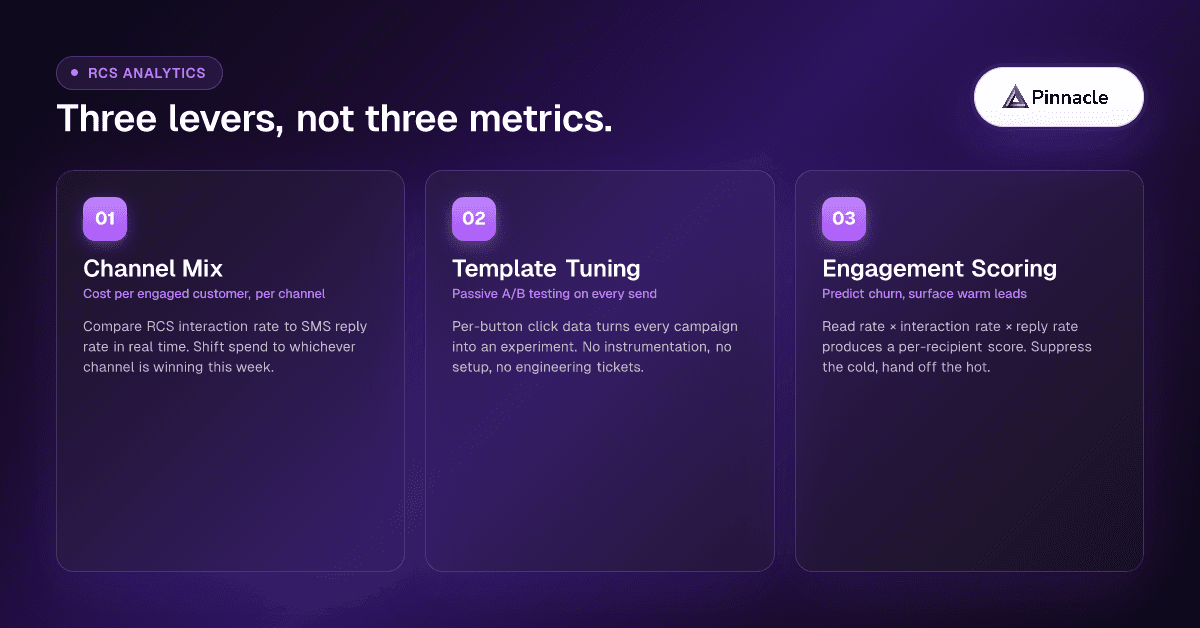 Three levers RCS analytics unlocks: channel mix optimization, template tuning, and predictive engagement scoring — none of which are possible on raw SMS.
These three levers are not the only ones. They are the three that we see deliver the largest dollar impact for teams in their first ninety days on the platform. There are dozens of smaller ones — drop-off detection inside multi-step flows, message timing optimization, regional performance comparisons — that emerge once the data is in your hands.
Why Most RCS Platforms Can't Give You This
This is the part that surprises people: the analytics layer Pinnacle exposes is not blocked by the carriers, the protocol, or the Google RBM API. It's blocked by every other vendor's architecture.
Here's the structural reason. Most RCS providers — Twilio, Sinch, Infobip, the carriers' own portals — treat RCS as a pass-through API. The flow looks like this:
- You send a message through their API.
- The carrier delivers it.
- The recipient interacts with it (reads it, taps a button, sends a reply).
- The carrier emits a webhook event.
- The vendor's platform forwards that webhook event to your webhook endpoint.
- Your engineering team is now responsible for receiving it, parsing it, storing it, indexing it, aggregating it, and building the dashboard on top.
Step 6 is where every messaging analytics initiative dies. For most teams, step 6 means:
- A backlog ticket that never makes it to the top of the priority list
- A first-pass implementation that captures raw events into a logs table no one queries
- A Looker or Metabase dashboard that takes three days to build and gets opened twice
- A six-month half-finished project that gets abandoned when the engineer who started it changes teams
The result is an industry-wide blind spot. Hundreds of millions of RCS messages go out every day with rich interactive elements, and almost nobody — not even the senders — knows which buttons get pressed. The data exists, it's flowing through the carrier pipes, and it's getting dropped on the floor at every vendor on the market except one.
Pinnacle inverts the architecture. Instead of relaying events to your webhook endpoint and walking away, we capture every event into our own infrastructure first, normalize it across carriers, store it with a stable schema, aggregate it in real time, and expose it as a dashboard and a per-recipient conversation view. The infrastructure work is finished. You don't have to build it.
For the side-by-side teardowns, see Pinnacle vs. Twilio, Pinnacle vs. Sinch, and Pinnacle vs. Infobip.
Where the Data Lives — Two Access Surfaces
Pinnacle exposes the analytics layer through two different surfaces, each pointed at a different audience inside your company.
The Analytics Dashboard
For non-engineering stakeholders — marketing, growth, product, ops, the executive team. Real-time. Zero setup. You log in, you see your delivery rates, your interaction rates, your message mix, your read rates, your button breakdowns. You filter by date range, by channel, by sender. You drill from aggregate metrics into individual messages and back out. No SQL, no warehouse access, no engineering ticket.
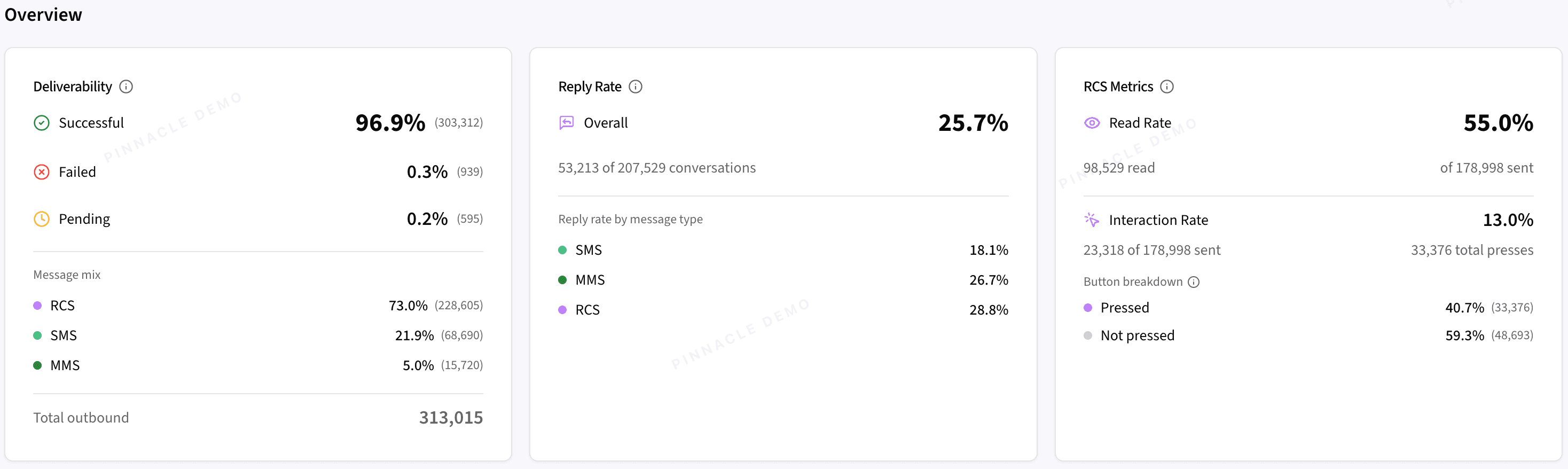 The dashboard hero: deliverability at 96.9%, reply rate at 25.7%, RCS read rate at 55.0%, interaction rate at 13.0%, button breakdown — pressed vs not pressed — all computed automatically.
This is the surface most non-technical teams live in day to day. It exists because most messaging analytics tools assume the only people who care about the data are engineers, and that has never been true.
The Conversations View
For support and operations. The conversations view shows the per-recipient timeline — every outbound message, every reply, every read receipt, every button click, every reaction — in order. When a customer calls support and says "the link in your message didn't work," the support rep can pull up the conversation, see the exact message that was sent, see whether the customer pressed the button, see the timestamp, and resolve the ticket without escalating to engineering.
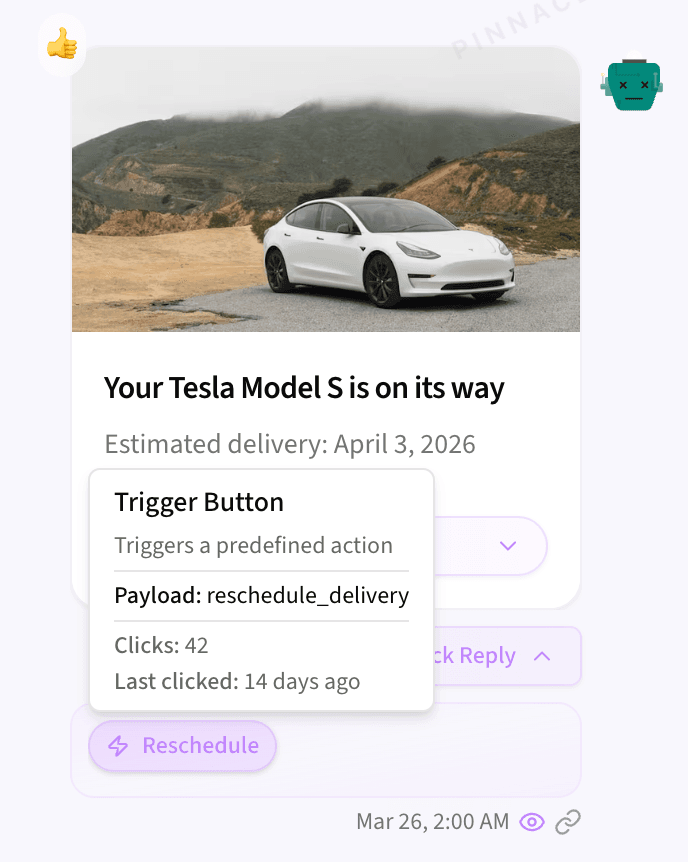 A rich card delivered via RCS with a "Reschedule" trigger button. The conversation view shows the per-message click count (42), the last click timestamp (14 days ago), and the payload — all inline, no engineering ticket required.
This is the same surface covered in the conversations dashboard post — the relevant point here is that the analytics signals are built into the conversation view, not hidden in a separate analytics tab. Context lives where the conversation lives.
The point of the two-surface model is that the same telemetry drives both views. The aggregates a marketer sees in the dashboard and the per-recipient timeline a support rep scrolls through in the conversation view come out of the same pipeline, so there is no "the dashboard says one thing and the conversation says another" problem.
A Worked Example: Turning Analytics Into Revenue
Here's how this plays out in practice. The setup is a hypothetical DTC retailer running an abandoned-cart messaging program. They've been on SMS for two years and are evaluating RCS.
Week 1. They sign up for Pinnacle and switch 50% of their abandoned-cart sends to RCS, keeping the other 50% on SMS as a control group. Zero engineering effort — Pinnacle handles RCS-to-SMS fallback automatically for any recipient whose device doesn't support RCS.
Week 2. They open the analytics dashboard. The numbers are stark: the RCS cohort shows a 22% interaction rate (recipients who tapped a button on the cart-recovery message). The SMS cohort shows a 3% reply rate. The cost per engaged customer on RCS is 35% lower than on SMS, even with the higher per-message price.
Week 3. They drill into the per-button breakdown. The RCS message has two CTAs: "Resume checkout" and "View cart." The data shows "Resume checkout" outperforms "View cart" by 41%. They swap "View cart" out across the entire campaign. No engineering ticket — just a content change in the template.
Week 4. They use the engagement-score data to identify the top 15% of recipients who interacted with the cart-recovery message but didn't convert. That cohort gets handed off to a higher-touch sales SMS sequence with a manual discount code. Conversion on the handed-off cohort lifts another 12%.
Net outcome at 30 days: measurable revenue lift, attributable to four data-driven decisions the team would not have been able to make on raw SMS or on a non-instrumented RCS provider. None of the four decisions required an engineering sprint. None of them required a custom analytics build. All of the data was sitting in the dashboard from day one.
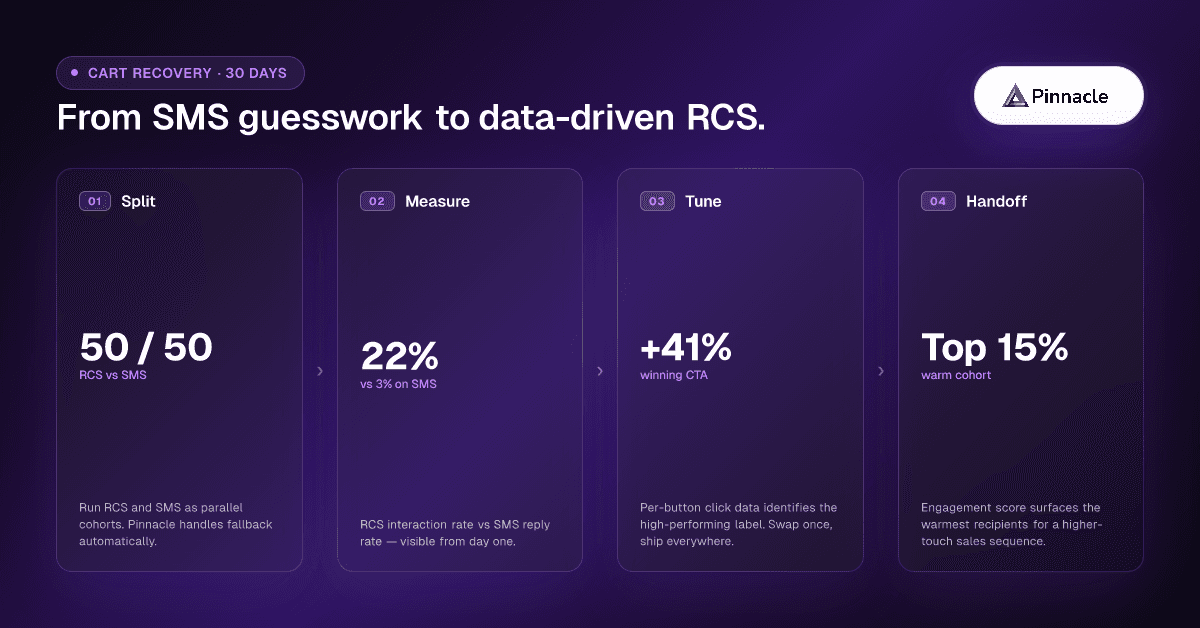 A 30-day cart-recovery arc on Pinnacle: split traffic 50/50, measure 22% RCS interaction vs 3% SMS replies, tune the winning CTA for +41%, hand off the top 15% engagement cohort.
The reason this kind of ninety-day arc isn't more common in the industry isn't that the techniques are hard. They're not — every one of them is a basic optimization any growth team could execute. The reason is that the underlying data has not, until now, been available without months of custom engineering work. Pinnacle is what closes that gap.
Why Pinnacle Is Best in Class
Five reasons. No fluff.
- Automatic, not opt-in. Every interaction is tracked from message #1 with zero configuration. There is no "enable analytics" step, no schema to register, no webhook handler to write.
- Normalized across carriers. The same data shape regardless of which carrier delivered the message. You don't have to handle ten different webhook formats or care which carrier the recipient happens to be on.
- Real-time, not batch. The dashboard and webhooks update as events arrive. There is no overnight batch job, no twenty-four-hour reporting lag, no "last refreshed" timestamp on the dashboard from yesterday afternoon.
- Unified across SMS, MMS, and RCS. One dashboard, one source of truth. Your channel mix, your delivery rates, your interaction rates, your reply rates — all in one view, comparable across channels.
- Included, not an upsell. Analytics is part of every Pinnacle account at no additional cost. There is no "analytics tier" or "enterprise add-on." If you're sending messages through Pinnacle, you have access to every signal in this post.
This is the bar. Every other RCS platform we've evaluated falls short on at least three of these. Most fall short on all five.
Frequently Asked Questions
Do I need to instrument anything to get button-click tracking?
No. Every interactive element in every RCS message you send through Pinnacle is indexed at send time, and clicks are tracked in real time as they arrive from the carrier. There is no SDK call, no webhook handler, no schema registration. You send a message with buttons, recipients press them, the data appears in your dashboard.
How does Pinnacle handle interaction data when a message falls back from RCS to SMS?
When Pinnacle falls a message back from RCS to SMS — because the recipient's device doesn't support RCS, or the carrier doesn't, or the user is in a region without RCS coverage — the analytics layer marks the event clearly and tracks the SMS-applicable signals (delivery, replies) for that recipient. The dashboard breaks out RCS-delivered vs. SMS-fallback volume so you always know which share of your traffic is producing rich telemetry vs. basic SMS metrics. See RCS to SMS Fallback for the mechanics.
How is interaction rate calculated?
Interaction rate is the percentage of outbound RCS messages where at least one button was pressed by the recipient: (messages with at least one click / total RCS messages sent) × 100. The dashboard also exposes the per-button breakdown — of all individual buttons sent, what percentage were pressed at least once — which is a more granular metric for understanding whether your button design is driving consistent engagement.
Does this work for international RCS traffic?
Yes. Pinnacle's analytics layer is normalized across every carrier in the global RCS ecosystem, with the same data shape regardless of region. International RCS traffic shows up in the dashboard identically to domestic traffic.
Is there a separate cost for analytics?
No. Every signal in this post — delivery telemetry, read receipts, interaction tracking, button-level breakdowns, engagement metrics, conversation-level signals, cost telemetry — is included with every Pinnacle account at no additional charge. There is no analytics tier, no per-event billing, no upsell.
Key Takeaways
- RCS analytics isn't a feature, it's the point. The protocol's real value over SMS is the telemetry, not the carousels.
- Pinnacle captures the full interaction surface automatically. Delivery, read, button clicks, quick replies, reactions, replies, conversation-level signals — every signal RCS exposes, normalized across carriers.
- The data is leverage, not vanity. Channel mix optimization, message template tuning, and predictive engagement scoring are decisions you can make with this data and cannot make without it.
- Most RCS platforms drop this data on the floor. Pass-through architectures push the analytics build onto your engineering team, where it dies in the backlog.
- Two access surfaces. Dashboard for non-engineers, conversation view for support and ops — same telemetry, surfaced where each team already lives.
- Zero configuration, real-time, no extra cost. It works the moment you send your first message, and it's included with every account.
- This is what best in class actually means. Not "we have a dashboard." Automatic, normalized, real-time, unified, free.
Get Started
If you're already on Pinnacle, every signal in this post is already flowing into your account. Visit the analytics dashboard to see your current interaction metrics, or open any conversation in the conversations dashboard to see button clicks and read receipts in context.
Want to see how Pinnacle fits your stack? Book a 30-minute call with one of our engineers — we'll walk through your use case and get you live.
To go deeper on any of the topics here, see the Pinnacle Analytics Dashboard walkthrough, the technical mechanics of button-click tracking, and the business case for switching from SMS to RCS. For the API and SDK reference, see the Pinnacle docs. If you have questions about how this would work for your specific use case, get in touch and we'll walk you through it.